Category: Announcement

  • Why ABA clinics keep losing staff and what the data says about fixing it

    Most ABA clinic owners do not have a demand problem. Referrals come in, waitlists grow, and the phone keeps ringing. What they have is a staffing problem. There are not enough Board Certified Behavior Analysts and Registered Behavior Technicians to meet the caseload, and the ones already on the team are hard to keep.

    If you run or staff an ABA practice, you already know this. The harder question is what to actually do about it, and that is where guessing gets expensive.

    The turnover math is worse than it looks

    RBT turnover in particular runs high across the industry. Every departure carries costs that do not show up cleanly on a balance sheet: recruiting time, onboarding hours, supervision ramp-up, and the disruption to clients who lose a familiar technician partway through their treatment plan. For a young learner, a mid-program staffing change is not a minor inconvenience. It can set progress back.

    When a clinic loses a technician, it often loses billable hours too, because new hires cannot carry a full caseload on day one. So turnover quietly caps how many clients a practice can serve, even when demand is high and the waitlist is long.

    Pay is usually the first thing blamed, and often misread

    When someone resigns, the easy explanation is money. Sometimes that is right. But clinics frequently misjudge where their pay actually sits, because they are comparing against stale numbers or against the wrong market entirely. A salary that felt competitive two years ago may now sit below the local median, and a clinic in one metro may be benchmarking against rates that only make sense in another.

    This is where current, local data matters more than instinct. Knowing the real BCBA and RBT pay ranges in your specific market, not a national average from an old survey, tells you whether your offer is the actual problem or just the convenient scapegoat. Workforce intelligence platforms such as abainstitute.org track live salary benchmarks, active employer hiring, and provider supply by region, which gives owners a grounded picture of what they are competing against before they restructure a pay scale or lose another hire to a clinic down the road.

    Getting this right cuts both ways. Some clinics are underpaying and do not realize it. Others are overpaying out of fear and could redirect that budget toward the things that actually drive retention.

    What keeps people, beyond the paycheck

    Pay gets someone in the door. It rarely keeps them. The reasons technicians and analysts tend to stay tend to cluster around a few practical things:

    Manageable caseloads. Burnout is the quiet driver of ABA turnover. When supervision ratios stretch too thin and technicians feel unsupported with difficult cases, they leave even when the pay is fair.

    A real path forward. RBTs who see a route toward becoming a BCBA, with tuition support, supervised hours, and a clinic that treats credentialing as an investment rather than a favor, have a reason to stay through the hard months.

    Reasonable administrative load. Hours lost to redundant paperwork and clunky systems are hours not spent with clients, and they are a common source of frustration. Clinics that streamline the documentation side give their staff more of the work they actually came to do.

    Being heard. Technicians who feel their observations shape treatment decisions stay longer than those who feel like interchangeable hands.

    None of this is exotic. It is just rarely measured, so it rarely gets fixed.

    Hire against the market, not against last year

    The clinics that staff well treat hiring as an ongoing read of their local market rather than a scramble that starts when someone quits. They know what competing employers in their area are paying and posting. They know whether the technician supply in their region is tightening or loosening. And they set offers and growth plans against that reality instead of against whatever they did the last time they hired.

    The staffing shortage in ABA is real and is not resolving quickly. But a clinic that understands its own market, pays accurately for it, and gives people genuine reasons to stay will hold its team together far better than one that reacts to each resignation in isolation. The demand is there. The deciding factor is whether you can keep the people to meet it.
  • OpenAI Retires GPT-4.5 Model from ChatGPT Website and API

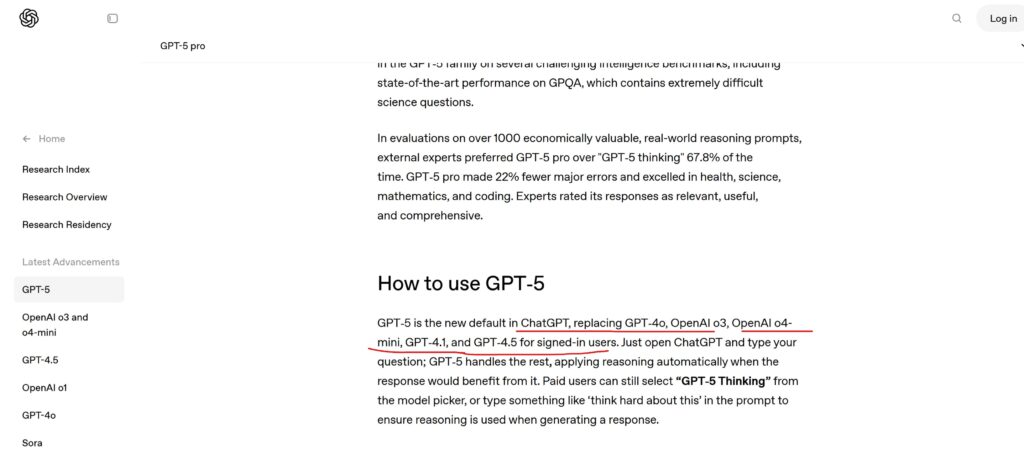
    OpenAI has officially removed the GPT-4.5 model from both the ChatGPT website and API as of August 2025. This change coincides with the release of GPT-5, launched on August 7, 2025, marking a significant update to the company’s AI offerings. As part of these changes, several older models—namely GPT-4.5, GPT-4o, GPT-4.1, among others—have been retired from all user-facing ChatGPT products and API endpoints.

    source: https://openai.com/index/introducing-gpt-5/

    What Does the Removal Mean for Users?

    • Model Unavailability: GPT-4.5 is no longer selectable for any user tier on ChatGPT, including paid subscriptions like Plus, Pro, Team, Enterprise, or EDU.
    • API Deprecation: Developers accessing OpenAI’s API can no longer utilize GPT-4.5 endpoints; requests are redirected to GPT-5 wherever possible.
    • Automatic Transition: If users open previous conversations that used GPT-4.5, ChatGPT will automatically migrate them to the nearest GPT-5 equivalent for continuity.
    • Legacy Model Access: While some higher-tier subscribers may retain temporary access to legacy models for a limited time, most users are required to migrate to GPT-5.

    Why Is OpenAI Making This Change?

    OpenAI’s decision to discontinue GPT-4.5 and other older models is driven by a desire to simplify product offerings and encourage the adoption of GPT-5, which features improved performance, efficiency, and functionality. By streamlining the available models, OpenAI aims to reduce complexity for users and developers and focus support and resources on its latest advancements.

    “With the release of GPT-5…OpenAI retired several older models from both user-facing ChatGPT and the API. These retired models include GPT-4.5, GPT-4o, GPT-4.1, and several others. If you open an older conversation that used GPT-4.5, ChatGPT will automatically switch it to the closest GPT-5 equivalent. This change applies not only to the API but also to all paid user tiers…OpenAI did this to simplify their offerings and encourage migration to GPT-5, their latest and most advanced model.”

    Users and developers are encouraged to review OpenAI’s model documentation and ensure their applications and workflow are updated to utilize the new GPT-5 API and ChatGPT interfaces.


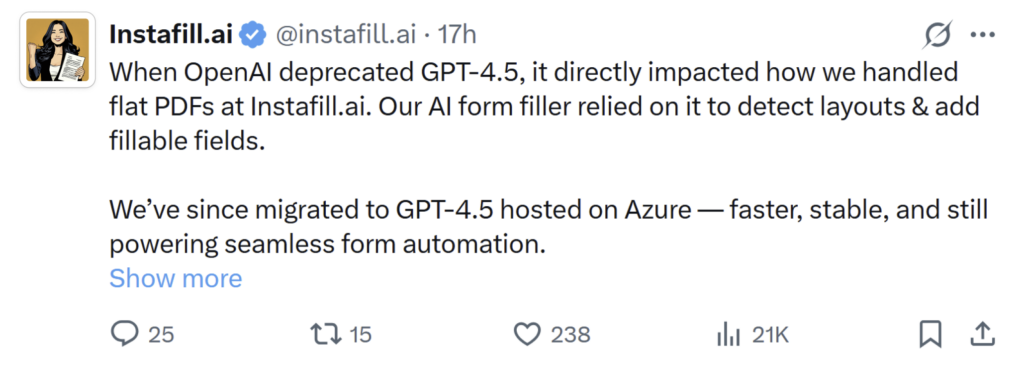
    Instafill.ai is moving to Microsoft Azure from OpenAI for the GPT 4.5 API

    Others struggled when OpenAI deprecated GPT-4.5 — breaking their document automation pipelines. For example. Instafill.ai, quickly migrated to GPT-4.5 hosted on Azure to keep their AI form filler running smoothly — still detecting layouts, adding fields to pd forms, and processing flat PDFs flawlessly.


    References:

    OpenAI official announcement and docs

  • Hipa.ai Sponsors the Premier 2025 Collaborator SEO Conference on May 23

    Hipa.ai Sponsors the Premier 2025 Collaborator SEO Conference on May 23

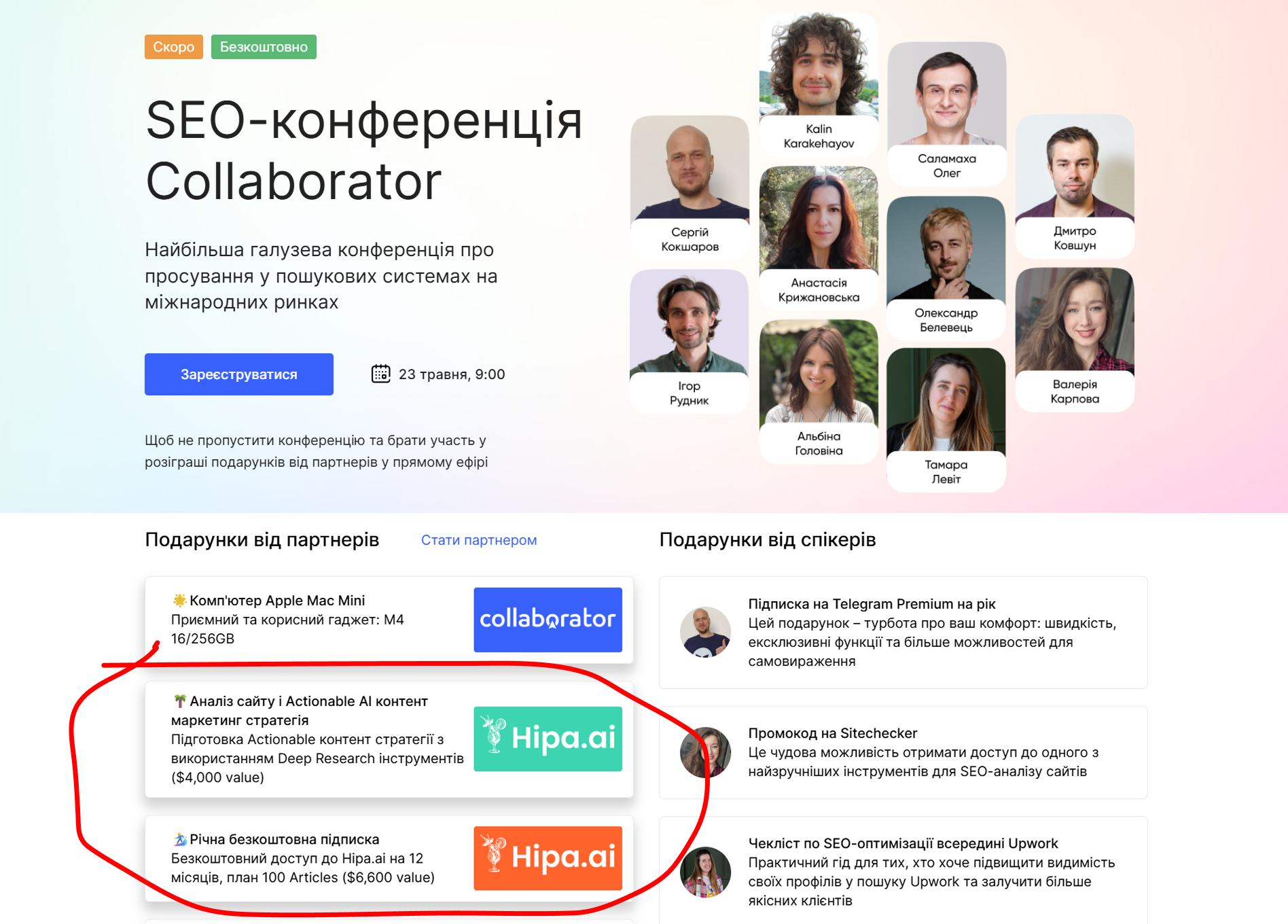
    This May 23, the SEO community will come together online for the Collaborator SEO Conference 2025 – one of the region’s premier search marketing events. Hipa.ai is proud to support this conference as a sponsor and partner. Our involvement underscores Hipa.ai’s commitment to advancing SEO practice through innovation and thought leadership in AI-driven content optimization.

    What to expect

    The Collaborator SEO Conference is known as the largest industry SEO event in Ukraine, with a focus on succeeding in Ukrainian and international markets. Attendees can look forward to a full day of actionable insights from forward-thinking SEO practitioners. The live-streamed sessions will cover a range of critical topics shaping search in 2025:

    • Technical & On-Page SEO – modern site architecture, Core Web Vitals, structured data, and more.
    • Content Strategy – creating, refreshing, and scaling content that meets Google’s latest quality signals.
    • Link Building 2025 – sustainable tactics that continue to deliver authority after recent algorithm updates.
    • Process Automation & AI – how advanced tools accelerate audits, keyword research, and content production.
    • Google Updates – first-hand analysis of the newest ranking factors and how to adapt.
    • Growth Playbooks – proven tips for expanding from the Ukrainian market to global SERPs.

    Expect a practical tone – every speaker plans to back up their insights with case studies and will take live questions from the audience in dedicated Q&A segments.

    Registration

    Participation is free, but registration is required.

    Once you’ve signed up, you’ll receive a confirmation email. On the morning of May 23, check your inbox again for your personal link to the live stream.

    Speaker Line-up

    One hallmark of this conference is the caliber of its speakers. Below is the line-up of confirmed experts and a glimpse of the knowledge they’ll be sharing:

    • Oleksandr Belevets (CEO, Traffic Kitchen) – “How to Prepare an SEO Pitch for a New Product.” Oleksandr will share how to craft a compelling SEO proposal for a new product launch, including identifying the right audience for the pitch and the key components that make an SEO pitch successful.
    • Tamara Levit (Technical AI Product Manager, Levit.tips) – “How Much Do Ukrainian SEO Specialists Earn on Upwork.” Tamara analyzes the earning potential of Ukrainian SEO freelancers on Upwork and discusses how the platform’s algorithms work, offering strategies for both independent freelancers and agencies to win more contracts.
    • Igor Rudnyk (CEO, Collaborator) – “Link Building in 2025: What You Need to Know to Reach the Top.” Igor will outline how link-building has evolved in recent times. He’ll classify which backlink strategies still work, debunk common myths, and answer the big question of how many links – and what kind – are truly needed to achieve top rankings.
    • Valeriia Karpova (Head of SEO, Boosta) – “Multiregional Websites in SEO: How to Get It Right.” Valeriia will discuss the nuances of multi-regional SEO, from choosing the optimal site structure (separate domains, subdomains, or subfolders for different markets) to crafting region-specific content and link strategies, as well as technical SEO considerations for multi-language or multi-country sites.
    • Serhiy Koksharov (SEO Blogger, Devaka.info) – “Analyzing Complex Sites with Simple Tools.” Known for his popular Devaka blog, Serhiy will demonstrate techniques to quickly audit and evaluate large websites using accessible tools. He’ll highlight must-have SEO browser plugins and scripts, and even show how to use Google Chrome DevTools and ChatGPT to automate parts of the SEO review process.
    • Dmytro Kovshun (Founder & CEO, Luxeo) – “Secrets of Building a Strong Affiliate SEO Team from Scratch: From Chaos to Profit.” Dmytro will share his journey of growing an affiliate marketing SEO business. Expect insights on how he started his team and projects, the volume of sites and backlinks required to succeed, mistakes to avoid, and which approaches ultimately yielded profitable results.
    • Oleg Salamaha (Founder, Serpstat) – “Traffic from AI: How an SEO Specialist Can Adapt.” Oleg will explore the impact of AI on search traffic. Using data from Serpstat, he’ll identify which types of search queries are losing clicks to AI-generated answers and discuss how SEO professionals can adapt. He’ll also point out opportunities to gain traffic via AI chatbots and voice assistants, and the emerging practice of monitoring your brand presence in AI answers.
    • Kalin Karakehayov (Founder, SEO.Domains) – “The Building Blocks of a Grey Hat SEO.” In this English-language session, Kalin will break down how to run a successful grey-hat SEO operation. He will talk about the mindset and team structure required, as well as the resources and skills needed to manage a large-scale, high-risk SEO project effectivelyconference.collaborator.proconference.collaborator.pro.
    • Albina Holovina (SEO Specialist, A11 Agency) – “From SEO Specialist to Clairvoyant: Methods of Forecasting Traffic with Different Data.” Albina will present techniques for predicting organic traffic. She’ll cover how to use various data sources to forecast traffic – from Google Analytics 4 and Google Search Console data (including using Google Sheets formulas and Python scripts with Ahrefs data) to leveraging free SEO plugins – and even how to estimate traffic potential for pages that don’t exist yet.
    • Anastasiia Kryzhanovska (Founder, Content KIT) – “Top SEO Content Trends in 2025: How to Adapt and Win.” Anastasiia will close out the day with a forward-looking talk on content strategy. She’ll examine emerging trends like Google’s Search Generative Experience (SGE) and AI answers that might siphon traffic, and explain how to create content that remains visible (and even gets featured in AI-driven results). Additionally, she will discuss optimizing content for AI assistants (ChatGPT, Bard/Gemini, etc.), building trust with Google’s E-E-A-T principles, combining formats (text, video, images) for maximum reach, and using AI in content creation without losing SEO rankings.

    Event snapshot

    ItemDetails (Kyiv time)
    DateFriday, May 23, 2025
    Time09:00 – 18:00 (live stream)
    Format100 % online, live Q&A after every talk
    HostCollaborator.pro
    PartnerHipa.ai

    See you on May 23 for a full day of fresh insights, practical tactics, community networking and stay for the exclusive gifts from Hipa.ai.